Varnish Config Language (VCL):
Backend
Backends where the actual content are present.
Use backend to create a named backend object.
backend some_backend {
    .host = "x.x.x.x";
    .port = "1234";
    .probe = some_probe;
}
Probe
Queries backend to check if the backend is up. Can query a particular url (default: /) to see if backend is up.
probe some_probe {
	.url = "/test";
	.timeout = 300 s;
	.interval = 10s;
}
Access Control List (ACL)
Create an ACL which can be used to match client addresses.
acl localnetwork {
    "localhost";
    "192.168.1.0"/24;
}
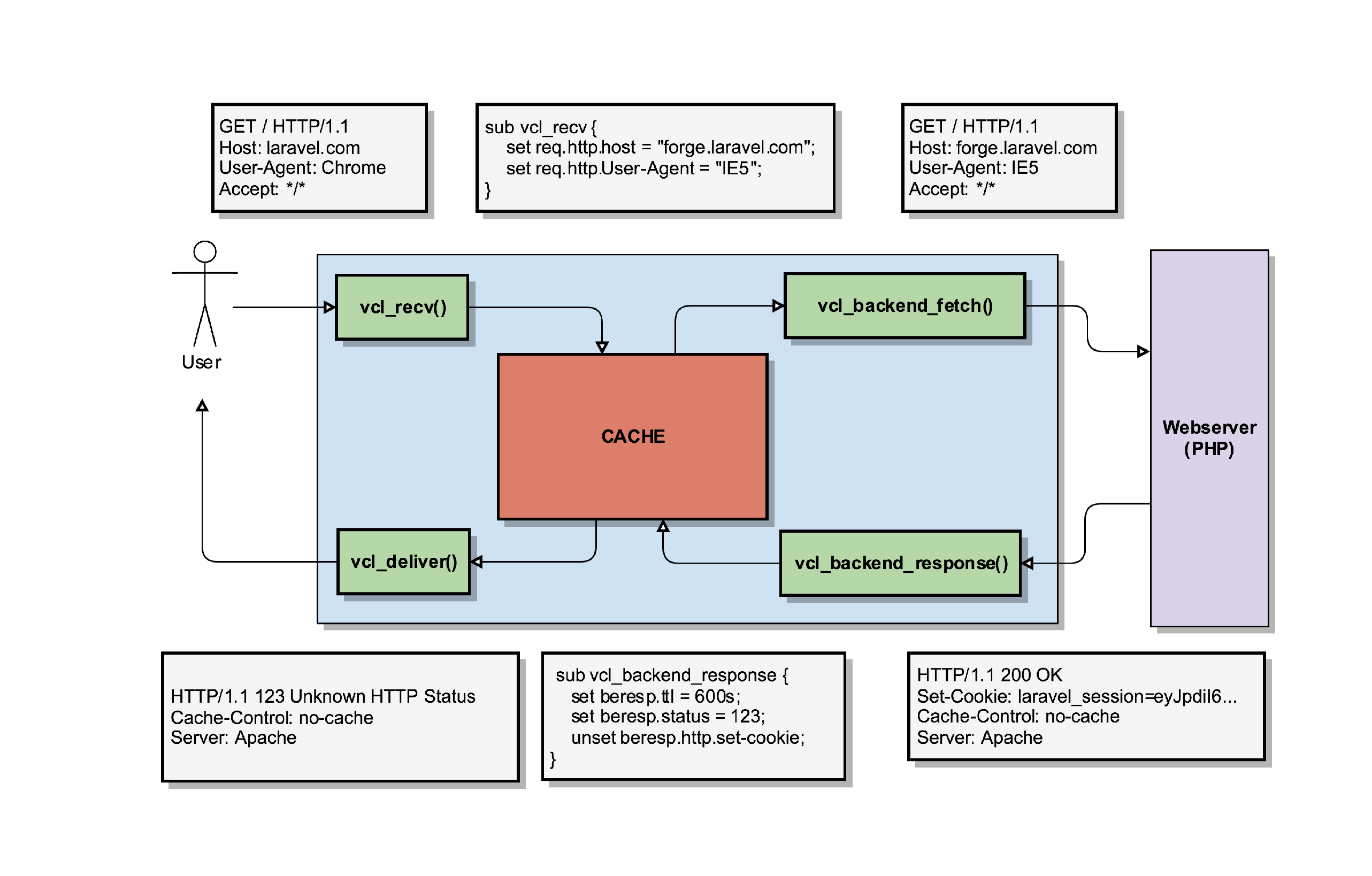
4 main routines:
-
vcl_init(): The first procedure that runs when varnish is started. Do stuff that needs to be done before any requests are served, like initializing modules etc. -
vcl_recv(): takes client’s request and processes it. Make whatever changes you want to here, includingsetting andunsetting headers. -
vcl_deliver(): the final request that is served to the client by varnish. -
vcl_backend_fetch(): request made by varnish to the actual backend. -
vcl_backend_response(): reponse sent back to varnish by the actual backend.
Flow Diagram
Keywords
-
set: Set/Change incoming request parameters. -
unset: Remove incoming request parameters.
Variables
-
bereq: The entire backend request HTTP data structure. -
beresp: The entire backend response HTTP data structure.bereq.backend/beresp.backend: Corresponding backend objects.
-
req: The entire HTTP request data structure.req.backend_hint: Set a backend that will be used to fetch the request.
-
resp: The entire response HTTP data structure.
Also, the above variables have a http object which has corresponding HTTP headers.
-
client,local,remote,server: similar objects, all haveipattribute which returns corresponding IP. -
now: current time object.
Return Actions
-
pass: The request and subsequent response is passed to backend instead of being served from the cache. Mainly used for dynamic pages, so it is not cached. -
deliver: deliver the object to client. -
pipe: Used to stream large objects, such as videos to avoid timeouts. Using pipe means Varnish stops inspecting each request, and just sends bytes straight to the backend. -
hash: if called fromvcl_recv(), varnish delivers content from the cache, even if the request otherwise indicates that the request should be passed. -
purge: invalidates caches explicitly using objects' hashes. For example,
sub vcl_recv {
    if (req.method == "PURGE"){
       return (purge);
    }
}
In the example above, return (purge) ends execution of vcl_recv and jumps to vcl_hash. When vcl_hash calls return(lookup), Varnish purges the object and then calls vcl_purge.

Share this post
Twitter
Facebook
Reddit
LinkedIn
Email